

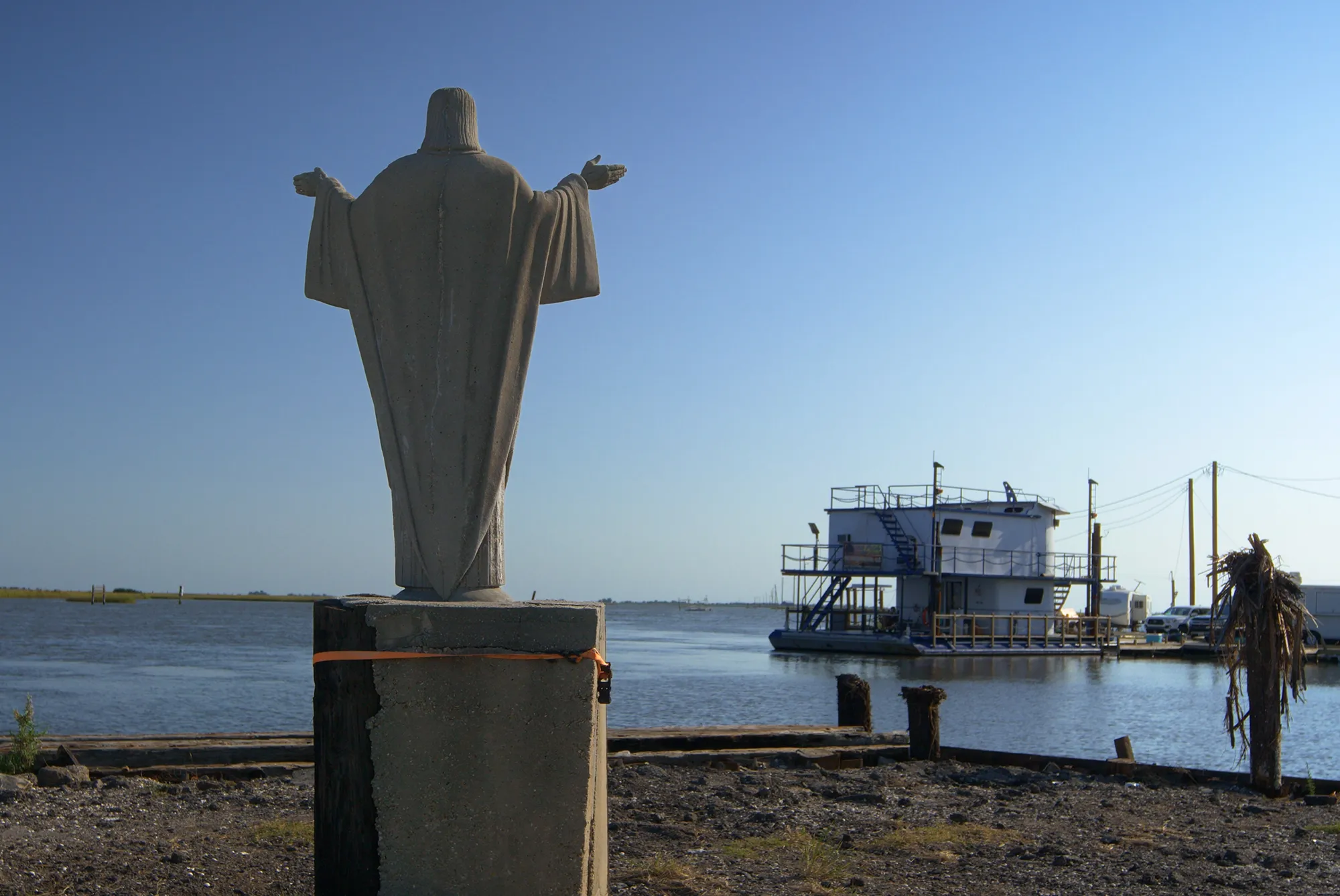
Still from Terrebonne, 2025. Courtesy the artists Adriana Corral and Janaye Brown.
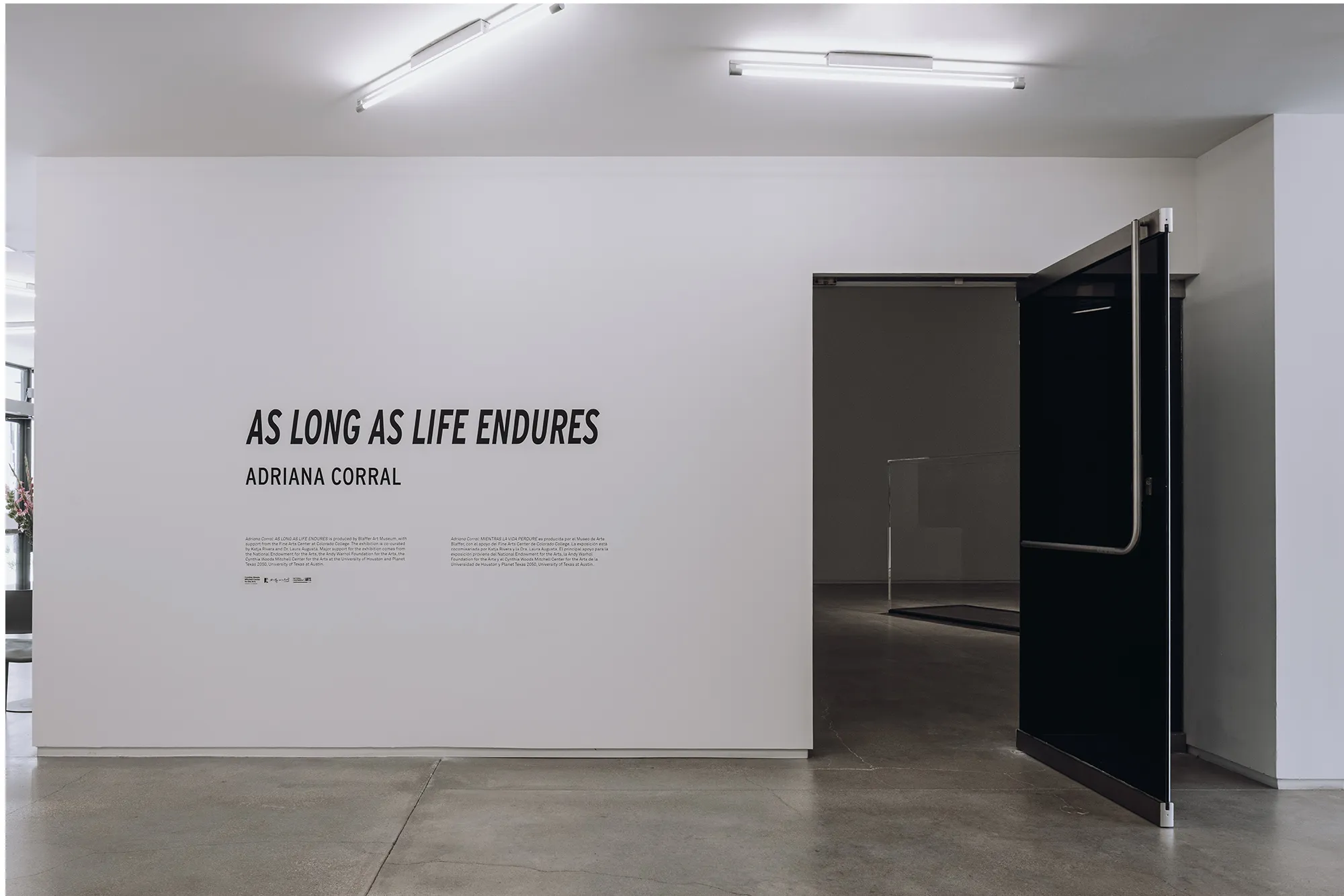
Adriana Corral: AS LONG AS LIFE ENDURES
August 22, 2026—December 5, 2026


Adriana Corral studies the relationship between protection and vulnerability, resilience and change. The title of the exhibition is inspired by the hymn Amazing Grace. Written by John Newton (1725–1807), a slave trader who converted to Christianity and later became a committed abolitionist, the hymn carries a history of transformation. Building from the song’s history, Corral has developed a body of work that considers the promises and failures of the laws, systems, and faiths that claim to safeguard society’s most vulnerable.
Anchoring the exhibition is a ballistic cube modeled on dimensions of an inverted burial plot (4 x 8 x 6 feet) and made from transparent acrylic. Here, Corral references above-ground mausoleums often found in waterlogged ecologies. The transparent material recalls the origins of bulletproof glass, developed in the early 20th century for medical and military applications. Today the material is widely used to safeguard political leaders, financial assets, and even iconic works of art. Part sanctuary and part memorial, Corral’s sculpture makes visible the contradiction of protection: its capacity to guard a chosen few and its inability to prevent loss. Accompanying the sculpture is a new copper etched panel featuring the hymn Amazing Grace, hand-drawn by the artist. Treated with acid, liver of sulfur, and verdigris patina, the surface is left to undergo a continuous process of oxidation, an echo of the transformations evoked by the song.
A new film, Terrebonne, created in collaboration with Janaye Brown, highlights the intersection of environmental collapse and human rights. Corral is interested in the ways that weakened ecologies threaten the survival of communities already marginalized by civic neglect and governmental inaction. Terrebone documents the artist’s engagement with the Point-au-Chien tribe in the wake of Hurricane Ida. Mobilizing materials such as glass, oyster shells, copper, and sand, Corral connects ecology to human rights issues, foregrounding sites where histories of survival, vulnerability, and resilience converge.
About the Artist
Adriana Corral’s installations, sculptures, drawings and films confront histories that are often threatened by erasure. Her interdisciplinary, research-based practice explores themes of memory, loss, human rights abuses, natural disasters and the unacknowledged histories that are often hidden in plain sight.
Corral received her MFA from the University of Texas at Austin and completed her BFA at the University of Texas at El Paso. She was invited to attend the 106th session of the Working Group on Enforced and Involuntary disappearances at the United Nations in Geneva, Switzerland (2015) and awarded the Joan Mitchell Foundation Emerging Artist Grant (2016). Corral was an Artist Fellow at Black Cube, A Nomadic Art Museum (2017), an Artist Research Fellow at Archives of American Art and History at the Smithsonian Institution (2018), selected for the Latinx Artist Fellowship funded by the Andrew W. Mellon Foundation and the Ford Foundation (2021) and a Planet Texas 2050 Artist Fellow at the University of Texas at Austin (2023-24).
Exhibition Images




Exhibition Brochure
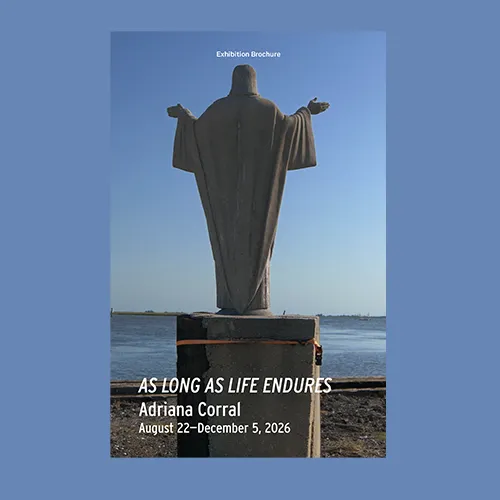
ALL THAT LIFE ENDURES | Exhibition Brochure
published by Blaffer Art Museum
In AS LONG AS LIFE ENDURES, Adriana Corral transmutes materials such as glass, oyster shells, copper, and sand, connecting ecology to human rights issues and foregrounding sites where histories of survival, vulnerability, and resilience converge. The four works on view derive from Corral’s ongoing examination of how life is valued and whose lives are deemed valuable. For the past five years, Corral has been involved in mutual aid and community-building work with the Pointe au Chien Indian Tribe, which has lived along the Louisiana Gulf Coast for centuries.